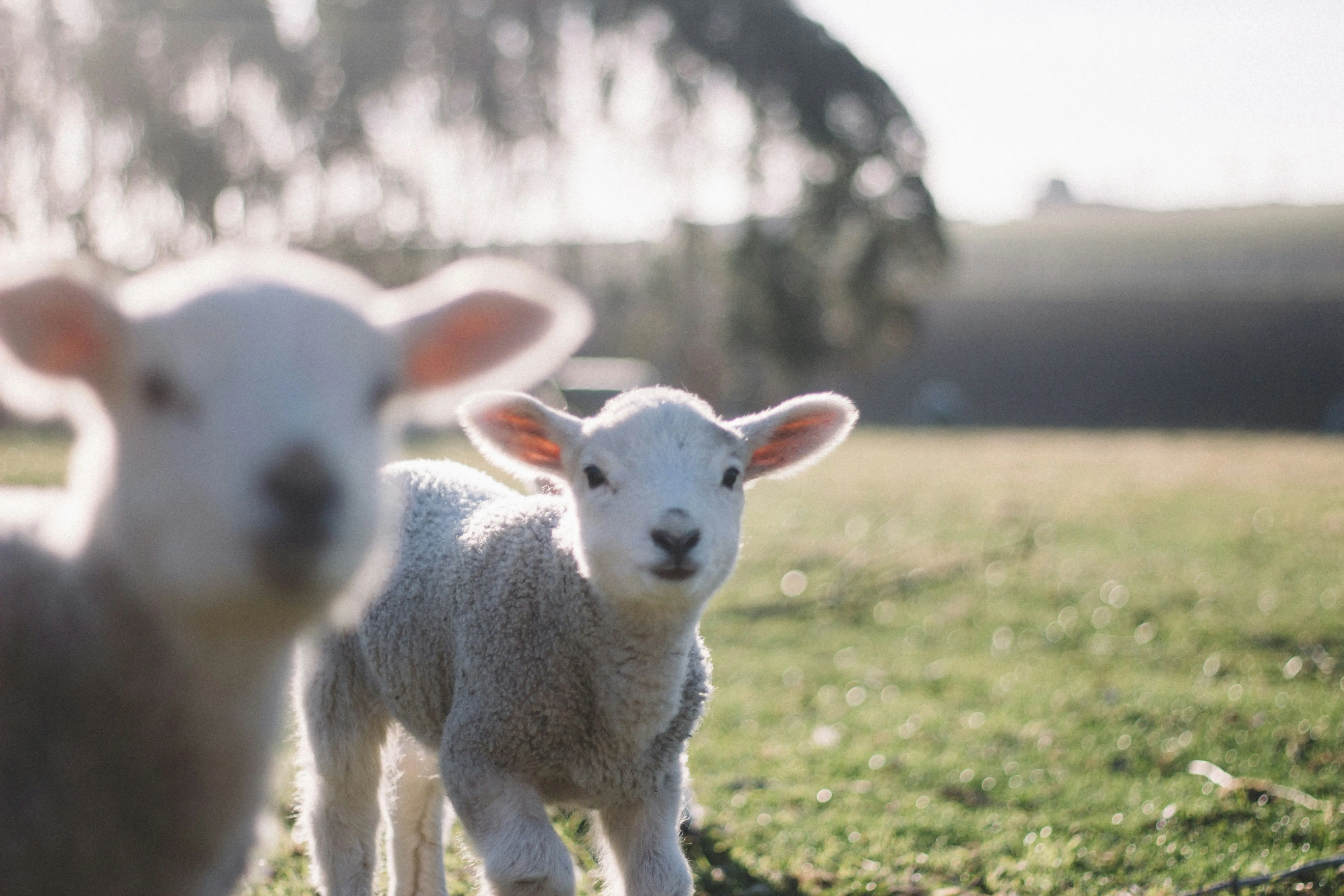
Stunned versus non-stunned halal
The Stun That Isn't: What's Really Happening to British Lamb Before It Reaches Your Plate
Inside the gap between religious certification, animal welfare law, and the biochemistry of fear.
A Tale of Two Currents
This article is about two things: what is happening to lambs in the stunned halal sector, and what that means for the ordinary consumer who buys supermarket lamb with no idea how it was killed. At the centre of both issues is a single number: the voltage of the electric current passing through a lamb's skull at the moment of stunning.
The legal minimum for electrical head-only stunning of sheep under the Welfare of Animals at the Time of Killing regulations is 1.0 amp. This figure is not arbitrary. Research by Gregory and Wotton, published in the British Veterinary Journal in 1984 and still the scientific basis for current legislation, established that 1.0 amp is the minimum current required to reliably pass through a sheep's brain and trigger a genuine epileptic seizure. Below that threshold, the current paralyses the animal's muscles without rendering it unconscious. It cannot move or vocalise. It may be fully aware of what is happening next. This is what welfare scientists call a sham stun — and the evidence suggests it is not rare in the stunned halal sector.
The University of Bristol and the Agriculture and Horticulture Development Board tested this directly. In a 2016 study published in the journal Animal Welfare (Orford et al., Vol. 25, Issue 3), researchers tested two commercial stunners in a working abattoir and found that one model — the Jetco MS100 — delivered a sham stun in 118 of 228 sheep tested. That is 52% of animals falling below the legal minimum — not occasionally, not as an edge case, but as the routine performance of equipment in active commercial use. The researchers noted pointedly that both units “may meet the requirements for halal slaughter where pre-stun is considered acceptable.” In other words, what the law classifies as a welfare failure, stunned halal certification was prepared to accept.
An industry source with direct knowledge of commercial lamb processing has described observing amperages as low as 0.5 amps in stunned halal abattoirs — half the legal minimum, and firmly in sham stun territory. This figure has not been independently verified in published regulatory data, but it is consistent with the Bristol study's finding that sham stunning occurs routinely in the stunned halal sector, and that certification requirements create commercial pressure to reduce current toward the point where a genuine stun becomes unlikely.
Head-to-body cardiac arrest stunning, used at higher amperages of 1.2 to 1.3 amps, produces a categorically different outcome. Brain activity studies published in Animal Welfare confirm that this method produces an epileptic-like episode followed by electrical silence in the brain — the definitive signature of irreversible unconsciousness. There is no sham stun risk at these parameters. The animal does not recover. But cardiac arrest stunning is by definition irreversible, and the stunned halal certifiers will not accept it — which leaves a structural gap between the only method that reliably works and the methods they will endorse.
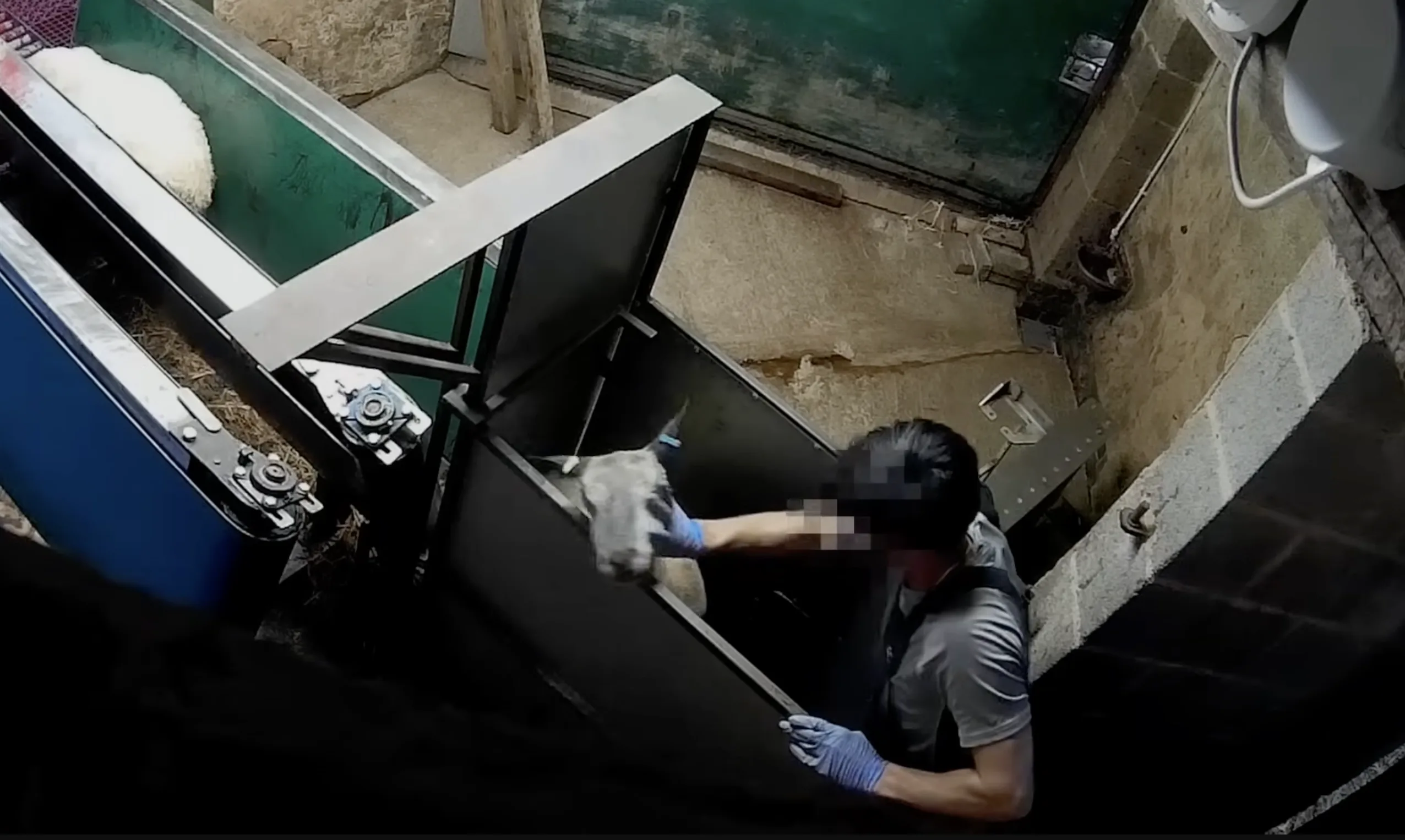
Sheep being moved through handling equipment at a halal slaughterhouse
Source: Still from “HALAL SLAUGHTERHOUSE EXPOSED IN ENGLAND (EXTREMELY GRAPHIC)”, Joey Carbstrong / YouTube. Watch on YouTube
The Certification Trap
The Halal Food Authority and equivalent bodies require that stunning be “reversible” — the animal must theoretically be capable of regaining consciousness if the throat cut did not follow. The Halal Food Authority's own published guidance specifies “controlled electric stun with minuscule amperage, verified by a veterinary surgeon.” A cardiac arrest stun is irreversible by definition: the heart stops. Stunned halal certifiers will not accept it.
The consequence is a structural incentive toward the sham stun. Abattoirs seeking stunned halal certification use head-only electrical stunning at the lowest amperages certifiers will accept. The intention is welfare: render the animal insensible, preserve halal validity, complete the cut. The reality, as the Bristol study demonstrates, is that equipment operating in this low-amperage range delivers a genuine stun only intermittently — and when it fails, what it delivers is not a humane preliminary to slaughter but a sham stun: paralysis without unconsciousness, followed by a blade to the throat.
An industry source describes the low-amperage stun not as a welfare compromise freely offered by certifiers, but as a pressure point in an ongoing push. Halal organisations, he notes, push for no stun at all. The reduced amperage represents a staging post toward that goal, not a concession away from it. The sham stun, in this reading, is not an accident of poor equipment management but the predictable outcome of a system designed to keep stunning as close to non-existent as legality allows.
What Fear Does to the Meat
There is a further dimension to this that goes largely unexamined in public debate: the effect on the lamb at a biochemical level, and how the stunned and non-stunned halal sectors differ in ways that reach the consumer's plate.
Lambs are prey animals with acute stress responses. When frightened — by transport, restraint, unfamiliar smells, or the sight of other animals being killed — their bodies release adrenaline, which triggers rapid breakdown of glycogen stored in the muscles. Glycogen is the fuel reserve that, after slaughter, converts to lactic acid and acidifies the meat. That acidification is not incidental. It inhibits bacterial growth, determines texture, affects colour, and governs shelf life. A well-rested lamb slaughtered calmly has sufficient glycogen to drive the acidity of its muscle down to the target range within 24 hours.
The glycogen picture differs significantly between the stunned and non-stunned halal sectors. A non-stunned halal kill — properly performed, with a calm animal and a sharp blade — can, in optimal conditions, preserve glycogen reserves, since the death is rapid and the animal has not undergone the violent muscular convulsion of a high-amperage electrical stun. A sham-stunned animal in the stunned halal sector gets the worst of both worlds: the stress and adrenaline surge of an inadequate electrical shock, without the glycogen-burning convulsion of a proper stun, followed by a conscious bleed-out. A properly stunned animal — at or above 1.0 amp — may burn more glycogen through the convulsion but reaches slaughter genuinely insensible.
The result, in the stunned halal sector operating with sham-stun-level amperages, is what the meat industry calls Dark, Firm, and Dry meat. The acidity stays too low. It spoils faster. It tastes different. Industry assessors describe it as livery and flat — the characteristic tang of lamb absent entirely. The sham stun, in other words, does not merely fail the animal. It also degrades the meat.
In Australia, dark cutting has been estimated at around 15% of sheep carcasses industry-wide (Australian Meat Processor Corporation review, 2017). In the UK, no equivalent systematic data exists broken down by slaughter method, certification type, or stunned versus non-stunned status. Abattoirs do not publish their records.
The Deepest Irony
The cardiac arrest method — 1.2 to 1.3 amps, head-to-body — eliminates the sham stun risk entirely. It definitively renders the animal unconscious by any measurable neurological standard. It is also, by the rules of the stunned halal certification bodies, unacceptable. Irreversible. Not halal.
The head-only method at low amperage is certifiable as stunned halal. According to the Bristol study, it delivers a sham stun in 52% of animals when run through a Jetco MS100 — the kind of equipment found in commercial abattoirs. The sham stun is not a theoretical risk. It is a documented, measurable, majority outcome of equipment in routine use.
The non-stunned halal sector is at least honest about what it is. According to the Agriculture and Horticulture Development Board's own senior sector manager, 72% of sheep slaughtered in England and Wales are killed according to halal processes. There is no legal requirement to label meat as halal. The consumer buying standard supermarket lamb — with no indication of slaughter method, no way of knowing — is, in the majority of cases, buying meat killed under halal conditions. Whether those conditions involved a genuine stun, a sham stun, or no stun at all is information they are currently not given.
Poland's Dirty Secret: The Unstunned Lamb Flowing into Europe
Germany bans it. France limits it. Denmark, Sweden and Slovenia have outlawed it entirely. Yet unstunned halal lamb continues to flow across European borders — and the source is Poland.
Germany bans it. France limits it. Denmark, Sweden and Slovenia have outlawed it entirely. Yet unstunned halal lamb — slaughtered by having its throat cut while fully conscious, then left to bleed out — continues to flow across European borders in significant quantities. The source, for much of Western Europe, is Poland.
Poland exported meat and meat products worth around €5 billion in 2020, of which almost a third was kosher and halal. The UK is explicitly listed as one of the major destinations alongside Germany, France, Spain and Israel. What makes this trade distinctive is that the Polish halal export industry is built specifically around unstunned slaughter — the throat-cut method without any prior rendering of the animal unconscious — produced not for Poland's own tiny Muslim population but almost entirely for export markets.
Unstunned ritual slaughter accounts for between 12% and 23% of Poland's total beef production and between 16% and 32% of its beef exports. In poultry the figures are higher still, with 9–22% of total production and 20–47% of exports being halal or kosher certified — and of that, 60–70% is unstunned. Lamb-specific data is not separately published, but the pattern follows the same model — a substantial minority of production, overwhelmingly export-driven.
In Germany, unstunned slaughter is illegal on animal welfare grounds — yet German halal butchers routinely import the product of exactly that practice from across the Polish border. German butchers have resorted to travelling to Poland to carry out slaughter that German law forbids at home, with one butcher reportedly slaughtering 100 lambs on a Polish farm for German customers in a single Eid al-Adha. The state bans the practice domestically, then allows the meat to be imported and sold without any requirement to declare how the animal died.
Poland attempted to close this loophole itself. Its parliament passed legislation to end the unstunned export trade, but the farming lobby — facing the loss of a $1.8 billion industry — fought back successfully and the law was dropped. The trade continues.
If the UK ever moves to ban unstunned halal slaughter entirely, controlling imports will be critical from day one. The infrastructure, the supply chains and the commercial incentives are already in place. Without tight border controls and mandatory slaughter method labelling, a black market in unstunned lamb and poultry from Poland and elsewhere would emerge almost immediately.
Sources
Source list
- Welfare of Animals at the Time of Killing (England) Regulations 2015.
- Gregory and Wotton, British Veterinary Journal, 1984.
- Orford et al., Animal Welfare, Vol. 25, Issue 3, 2016 (University of Bristol/Agriculture and Horticulture Development Board).
- Brain activity head-to-body stunning study, Animal Welfare journal.
- Halal Food Authority published guidance, halalfoodauthority.com.
- Food Standards Agency Annual Animal Welfare Reports 2018–2024.
- Australian Meat Processor Corporation, dark cutting review, 2017.
- Hansard, Non-Stun Slaughter Debate, June 2025.
- Industry source, October 2025.
- EU Meat News.
- Times of Israel.
- FSA Slaughter Survey 2024.
- Halal Food Information Centre UK.
- Notes from Poland.
- Polish Meat Association.