
FSA / Agricultural and Government Bodies
Halal Meat UK — FSA, Defra & Government Bodies
Food Standards Agency (FSA), Defra, local authorities, Red Tractor, and AHDB — with a long-form review of FOI obstruction on halal slaughter transparency.
A decade and a half of obstruction
Freedom of Information Requests on Halal Slaughterhouses, 2010–2026
How the FSA, Defra and Local Authorities Have Repeatedly Denied the Public the Right to Know
By Catherine Blaiklock — April 2026
Introduction
For over fifteen years, members of the public, journalists, animal welfare campaigners and elected councillors have attempted to obtain basic information from the Food Standards Agency (FSA), the Department for Environment, Food & Rural Affairs (Defra) and local authorities about which slaughterhouses in the United Kingdom operate under halal methods. The question they have been asking is simple: which establishments are authorised to carry out religious slaughter, and by what method?
The response, time and again, has been the same: the information does not exist in the form requested, the request is too broad and too costly to fulfil, the data is not held centrally, or — most strikingly — that releasing it is simply not in the public interest.
This document catalogues the known FOI requests made to public authorities on this subject and analyses the obstruction tactics used in response. It demonstrates a consistent and repeated failure to provide transparency on a matter of clear public concern: animal welfare, consumer choice, and the right to know what is in the food we eat.
Why the Public Has a Right to Know
Non-stun halal slaughter — where animals have their throats cut without prior stunning — is legal in the UK under a religious exemption to the Welfare of Animals at the Time of Killing (England) Regulations 2015 (WATOK). The FSA's own 2024 data shows that 30.1 million animals a year are slaughtered without pre-stunning. The British Veterinary Association, RSPCA, and scientific consensus are clear that this causes avoidable suffering, with cattle taking up to four and a half minutes to lose consciousness and sheep up to two minutes.
Consumers — whether motivated by animal welfare, religious beliefs, or personal ethics — have a legitimate interest in knowing whether the meat they buy has been produced by this method. That interest is inseparable from knowing which slaughterhouses are operating under halal certification. Yet the FSA does not publish this information, and when asked for it under the Freedom of Information Act, it has repeatedly declined to provide it.
There is a further legal dimension. The religious exemption in WATOK only permits non-stun slaughter where the meat is intended for consumption by Jews or Muslims. It is therefore unlawful to slaughter animals without stunning if the operator knows the meat will not be consumed by those communities. Without a publicly accessible list of which establishments hold the relevant approvals and certifications, it is impossible for regulators, local authorities, or the public to verify compliance with this legal requirement.
The FOI Requests: A Chronicle of Deflection
1. FOI 1670 – Kenneth Green (January 2015)
Request: A request to the FSA asking for the names of all halal slaughterhouses in the UK.
Response: The FSA's response is recorded under reference FOI 1670. This is the earliest publicly documented request on WhatDoTheyKnow specifically asking for a named list of halal slaughterhouses. The FSA declined to provide what was asked.
Obstruction tactic: Information not provided in the form requested.
2. Abattoirs Licensed for Halal Methods – Meat & Livestock Commercial Services (July–October 2015)
Request: A FOI request to the Agriculture and Horticulture Development Board's commercial arm asking for a list of abattoirs licensed to slaughter according to halal methods.
Response: No response was provided within the statutory 20-working-day period. The requester was forced to chase repeatedly and to request an internal review for non-response.
Obstruction tactic: Failure to respond within statutory deadline; stonewalling.
3. “Halal and Kosher” – FSA (circa 2016–2017)
Request: A member of the public asked the FSA whether it was correct that religious slaughter exemptions only applied where meat was genuinely destined for Muslim or Jewish consumers, and whether supermarkets selling it more widely were breaking the law.
Response: The FSA confirmed the exemption but declined to address whether retail practices were lawful, redirecting the requester to Defra on the grounds that labelling policy was not the FSA's remit.
Obstruction tactic: Jurisdictional ping-pong — deflecting to another department (Defra) and declining to answer the substantive legal question.
4. Mis-Stunning Figures – FSA (2016)
Request: A request for accurate figures on the number of animals mis-stunned per year — prompted by the discrepancy between the Health Minister's parliamentary claim of just 28 mis-stuns and EFSA figures suggesting rates of 9%–31%.
Response: The FSA acknowledged the request. No definitive reconciled figures were produced. The extraordinary gap between the official parliamentary answer and scientific estimates was never satisfactorily explained.
Obstruction tactic: Data inadequacy — official statistics so incomplete as to be misleading.
5. List of Slaughterhouses Approved for Religious Slaughter – Paul Perrin / FSA (FOI 2077, 2017)
Request: A request to the FSA for a list of all slaughterhouses approved for religious slaughter and specifically which were approved for non-stun slaughter.
Response: The FSA provided only a general link to its register of all approved food establishments — which does not identify which are halal or non-stun. The FSA's position was that slaughterhouses do not require separate registration to carry out religious slaughter; once approved, any establishment can do so if it meets operational requirements. It therefore claimed no separate list existed.
When the requester pressed further, asking at minimum for the number of establishments and their geographic distribution, the FSA provided limited aggregate data but continued to resist naming individual sites.
Obstruction tactic: Structural evasion — claiming no list exists because the regulatory framework was not designed to create one, thereby using a regulatory gap as a shield against transparency.
6. Halal Slaughterhouses in the UK – FOI 2315/2316 (October–December 2018)
Request: A request for the names of all halal slaughterhouses in the UK, submitted 29 October 2018.
Response (1 November 2018): The FSA said the information was not held.
The requester immediately reframed the request, asking for all data containing the word ‘halal’ in Official Veterinarian reports across slaughterhouses for the preceding three years.
Response (16 November 2018): The FSA confirmed it did hold such records — audit reports and partial audits across England and Wales — but rejected the request under Section 12 of the Act on cost grounds, saying compliance would exceed the statutory cost limit.
When the requester narrowed the request to halal meat and poultry slaughterhouses only, the FSA responded on 14 December 2018 with the same Section 12 cost refusal. An internal review was requested.
Obstruction tactic: First claimed data not held; when shown to be wrong, refused on cost grounds; when request was narrowed, refused again on cost grounds. A pattern of serial deflection.
7. FSA Inspection Reports on Non-Stun Abattoirs (2018)
Request: A detailed request for FSA inspection reports and audit records relating to UK abattoirs carrying out un-stunned slaughter, including CCTV use, animal welfare breaches, and enforcement outcomes.
Response: The FSA asked for multiple clarifications — what does ‘reports’ mean, what constitutes an ‘animal welfare issue’, what time period — before eventually processing the request. The use of repeated clarification requests as a delaying mechanism extended the response time considerably beyond the statutory 20-working-day deadline.
Obstruction tactic: Death by clarification — using repeated requests for information to delay and narrow a legitimate request.
8. Halal Restaurant Labelling – Anthony Lowery / FSA (2018)
Request: A member of the public asked why restaurants are not compelled to declare they are serving halal meat, and what plans exist to require such labelling.
Response: The FSA declined to handle the request under the FOI Act on the grounds that the requester was “not asking for recorded information.” It redirected the person to Defra.
Obstruction tactic: Definitional exclusion — treating a legitimate policy question as outside the scope of FOI; and jurisdictional deflection to Defra.
9. Councillor Tim Taylor / Fenland District Council FOI to Defra (circa 2023–2024)
Request: Councillor Tim Taylor (Conservative, March West and Benwick, Fenland District Council) submitted a Freedom of Information request to Defra approximately 18 months before the date of this document, seeking the establishment codes that would identify which slaughterhouses are operating as halal.
Response: The response stated that releasing the codes was not in the public interest.
Councillor Taylor has been a consistent campaigner on meat labelling, bringing multiple motions to Fenland District Council calling for halal slaughterhouses to be marked with an ‘H’ code, and writing to the FSA and Members of Parliament on the subject. The written FOI response is held privately.
Obstruction tactic: Public interest test used as a veto — the most striking refusal in this chronicle. A public body decided that the public does not have a right to know which slaughterhouses are producing religiously slaughtered meat.
10. FSA Animal Welfare Team – Ongoing FOI Activity (2023/24 and 2024/25)
Pattern: The FSA's own Annual Animal Welfare Reports record the volume of FOI requests received by the animal welfare team: 15 requests in 2023/24 and 9 in 2024/25. The most common themes were slaughterhouse operations and FSA enforcement.
The FSA presents this openness as a positive in its annual report, yet it does not pro-actively publish the information that would make such FOI requests unnecessary: a breakdown of slaughterhouses by method of slaughter.
Obstruction tactic: Reactive rather than proactive publication — forcing the public to ask, piecemeal, for information that should be published as a matter of course.
The Five Obstruction Tactics
Across these requests, a clear taxonomy of obstruction emerges:
- Structural evasion: “We don't hold a list of halal slaughterhouses because there is no registration requirement for halal slaughter.” This is technically true but deliberately unhelpful. The FSA has the data in its inspection records; it simply has not been organised to answer this question.
- Cost refusal (Section 12): Used repeatedly, even when requesters narrow their questions. The effect is that any question broad enough to be meaningful can be rejected as too costly, while any question narrow enough to be cheap is too limited to be useful.
- Jurisdictional deflection: Animal welfare is FSA. Labelling is Defra. Trading standards is the local authority. Each body points to another. The circularity is designed to exhaust the requester.
- Death by clarification: Repeatedly asking requesters to narrow or redefine their questions, consuming the 20-working-day window and forcing resubmission.
- Public interest veto: The most egregious tactic. Used by Defra in response to Councillor Taylor's request for establishment codes. A determination that telling the public which slaughterhouses are halal is contrary to the public interest is, in effect, a statement that the public's right to know what is in its food is less important than the interests of the halal industry in operating without scrutiny.
What Is Being Hidden and Why It Matters
Each approved slaughterhouse in England and Wales holds a unique establishment code — a number stamped on all meat leaving that facility. These codes are publicly visible on packaging. What is not publicly known is which of those codes belongs to a halal or non-stun operation. Councillors and campaigners have spent years cross-referencing codes against halal food websites and certification body records to establish this information — information that the FSA and Defra themselves hold.
The practical consequence is that consumers cannot make informed choices. A shopper buying chicken from a major supermarket has no way of knowing, from the packaging, whether it came from a non-stun halal facility. This is not a hypothetical concern: major supermarkets including Sainsbury's, Morrisons and Wetherspoons have been found, through persistent campaigning, to be selling religiously slaughtered meat without adequate disclosure.
There is also a legal compliance issue. WATOK makes non-stun slaughter lawful only where the meat is intended for Muslim or Jewish consumers. Halal meat is routinely sold into the mainstream supply chain. Hindquarters are sold conventionally. Kosher-rejected carcases enter the general market. The FSA's own data shows that 32% of non-stun sheep and 5% of non-stun chickens are exported — destinations not limited to Muslim communities. Without knowing which facilities are producing non-stun halal meat, there is no way to audit whether the legal conditions for the exemption are being met.
What Transparency Would Look Like
The following information should be proactively published by the FSA as a matter of routine:
- A list of all approved slaughterhouses, with their establishment codes, indicating whether each is certified for halal or kosher slaughter.
- For each halal-certified facility, whether it operates with or without pre-stunning, and which certification body (HFA, HMC or other) has certified it.
- Annual throughput data by slaughter method, broken down by establishment.
- Details of which establishments export non-stun meat and to where.
None of this requires new legislation. The FSA already holds this information. Publishing it would cost nothing compared to the cumulative cost of processing a decade of FOI requests on the same subject. The only reason not to publish it is to avoid scrutiny.
Conclusion
The FOI requests documented in this paper span twelve years and cover multiple public bodies. In every case, the outcome has been the same: the public has been denied straightforward information about which slaughterhouses produce halal or non-stun meat. The tactics used — structural evasion, cost refusals, jurisdictional deflection, serial clarification requests, and the public interest veto — are not the product of coincidence. They reflect a systemic unwillingness to subject the halal slaughter industry to the transparency that any other food production sector would face.
The most extraordinary single document in this record is the Defra response to Councillor Tim Taylor stating that releasing slaughterhouse codes is not in the public interest. It is worth pausing on what this means: a government department decided that British consumers do not have the right to know which facilities are slaughtering animals without stunning them. That decision was taken under a Conservative government, during a period when the same government was publicly committed to improving animal welfare standards.
The case for a judicial review of local authorities' failure to enforce the conditions of the WATOK religious exemption is strengthened by this record of obstruction. If the regulator will not publish the list, if Defra says releasing it is against the public interest, and if local authorities cannot say which establishments in their areas are operating under halal certification, then the law is being enforced blind. That is not a legal or regulatory system. It is a void.
Appendix: Summary Table of FOI Requests
Summary table to be added when prepared.
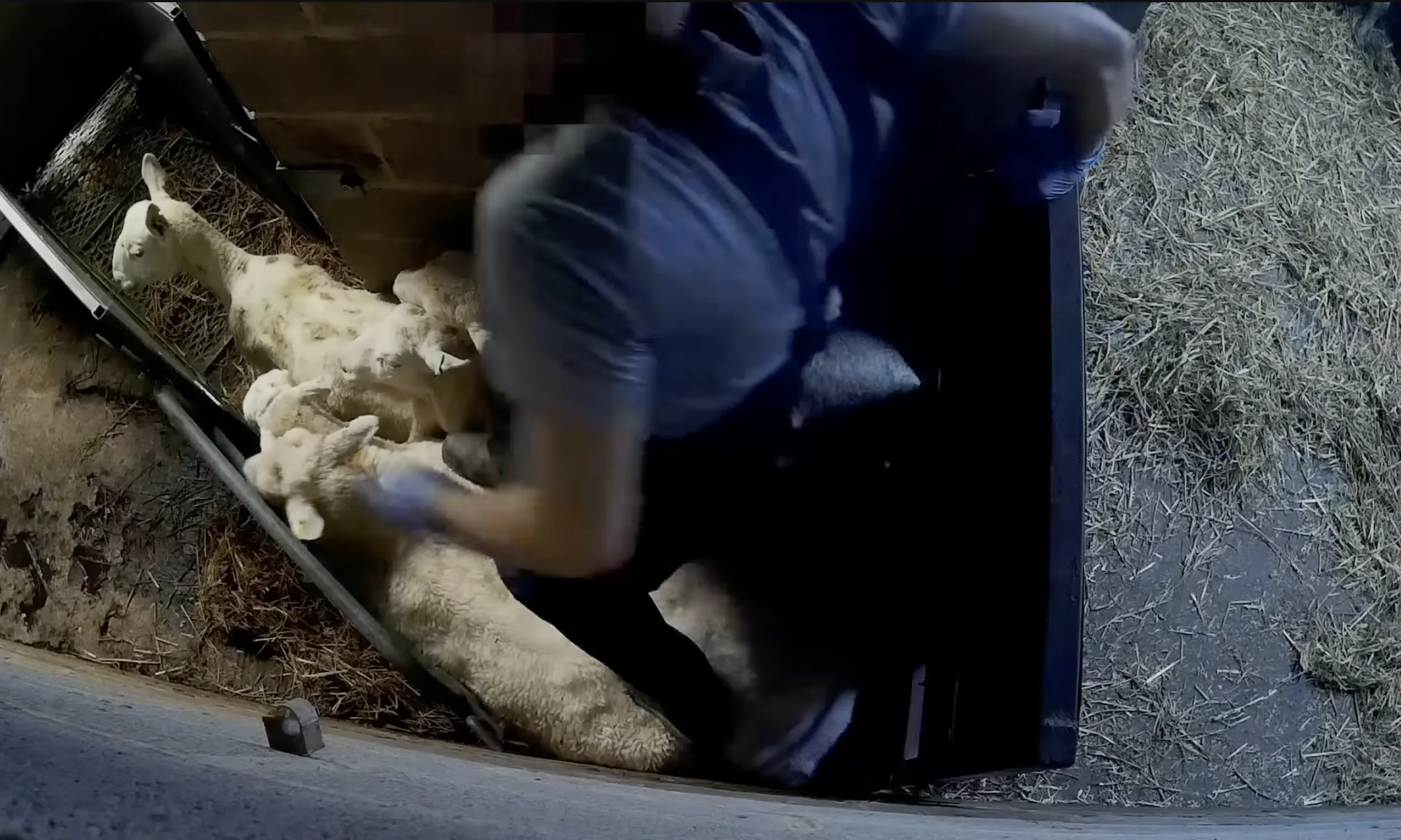
Conscious sheep on the slaughter conveyor before and during cutting
Source: Still from “HALAL SLAUGHTERHOUSE EXPOSED IN ENGLAND (EXTREMELY GRAPHIC)”, Joey Carbstrong / YouTube. Watch on YouTube
Defra (Department for Environment, Food & Rural Affairs)
Defra leads on wider food and farming policy, including matters often bounced between departments when requesters ask who should answer for halal retail, labelling, and establishment data. The FSA article above details a Defra FOI refusal on public-interest grounds over slaughterhouse establishment codes, and routine “jurisdictional” deflection from the FSA to Defra on labelling questions.
Red Tractor
Red Tractor is the UK's largest food assurance scheme, established in 2000 to certify that food products are traceable, safe, and produced responsibly to high standards. Its logo, often featuring a Union Jack, indicates the product is British, and has been farmed, transported, and packed according to rigorous, independent checks.
AHDB
Agriculture and Horticulture Development Board — market development for agriculture and horticulture in the UK.
Sources
Source list
- WhatDoTheyKnow.com — FOI requests to FSA (FOIs 1670, 2077, 2315/2316) and Meat & Livestock Commercial Services
- FSA Annual Animal Welfare Reports 2023/24 and 2024/25 (food.gov.uk)
- Fenland District Council — Published minutes of Full Council meetings, including Councillor Tim Taylor's motions on meat labelling (September 2025, December 2024)
- Welfare of Animals at the Time of Killing (England) Regulations 2015 (WATOK)
- FSA Slaughter Sector Survey 2018 (published by Defra/Welsh Government)
- BVA Policy on Non-Stun Slaughter (bva.co.uk)
- RSPCA Religious Slaughter Guidance (rspca.org.uk)
- FSA 2024/25 Annual Animal Welfare Report: 30.1 million animals slaughtered without pre-stunning