Cruelty
Cruelty
What the science actually shows about pain, distress, and the seconds between the throat cut and the loss of consciousness in non-stunned halal slaughter.
Source footage
Graphic clip from the same English halal slaughterhouse investigation used for the stills on this page. Viewer discretion advised.
Halal slaughterhouse footage (graphic)
Source: Still from “HALAL SLAUGHTERHOUSE EXPOSED IN ENGLAND (EXTREMELY GRAPHIC)”, Joey Carbstrong / YouTube. Watch on YouTube
What We Know About Suffering in Halal Slaughter
The core controversy in halal slaughter centres on one question: does an animal experience pain in the window between the throat cut and the loss of consciousness? The science is not comforting.
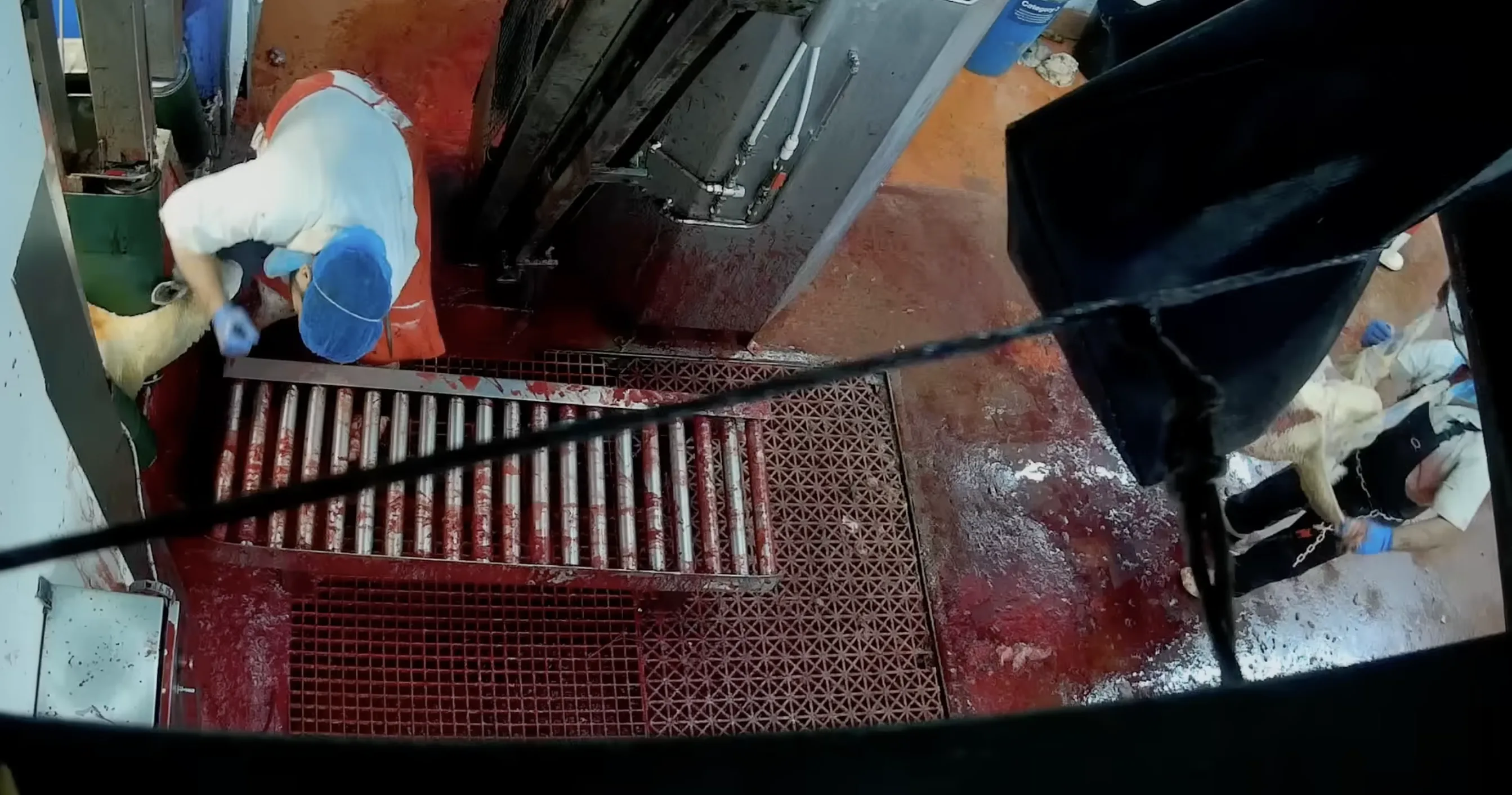
Sheep crowded in a pen inside an English halal slaughterhouse before slaughter
Source: Still from “HALAL SLAUGHTERHOUSE EXPOSED IN ENGLAND (EXTREMELY GRAPHIC)”, Joey Carbstrong / YouTube. Watch on YouTube
Traditional halal practice (dhabīḥah) requires a swift, deep incision across the throat, severing the carotid arteries, jugular veins, and trachea, while the animal remains conscious. The logic is theological: the animal must be alive at the point of cutting. Pre-stunning, while increasingly common in many Western halal-certified operations, remains banned or disfavoured in stricter interpretations. It is in those non-stunned settings where animal welfare research has documented its most disturbing findings.
For an animal to feel pain, nociceptive signals must travel from the spinal cord through the thalamus to the cerebral cortex, where both the sensory and emotional dimensions of pain are processed. Pain perception ceases only once blood flow drops below the threshold needed to sustain cortical function. The practical question, therefore, is how much pain the animal experiences in the seconds between the cut and that loss of consciousness. For sheep, that window is estimated at roughly 2 to 7 seconds. For cattle, it can be substantially longer.
For cattle, the situation is significantly worse. EEG readings in cattle indicate brain activity consistent with pain perception for anywhere between 20 and 60 seconds, sometimes longer, due to vertebral artery anomalies that delay the onset of cerebral hypoxia. This period involves severe distress, including thrashing, vocalization, and reflexive movements indicative of acute suffering.
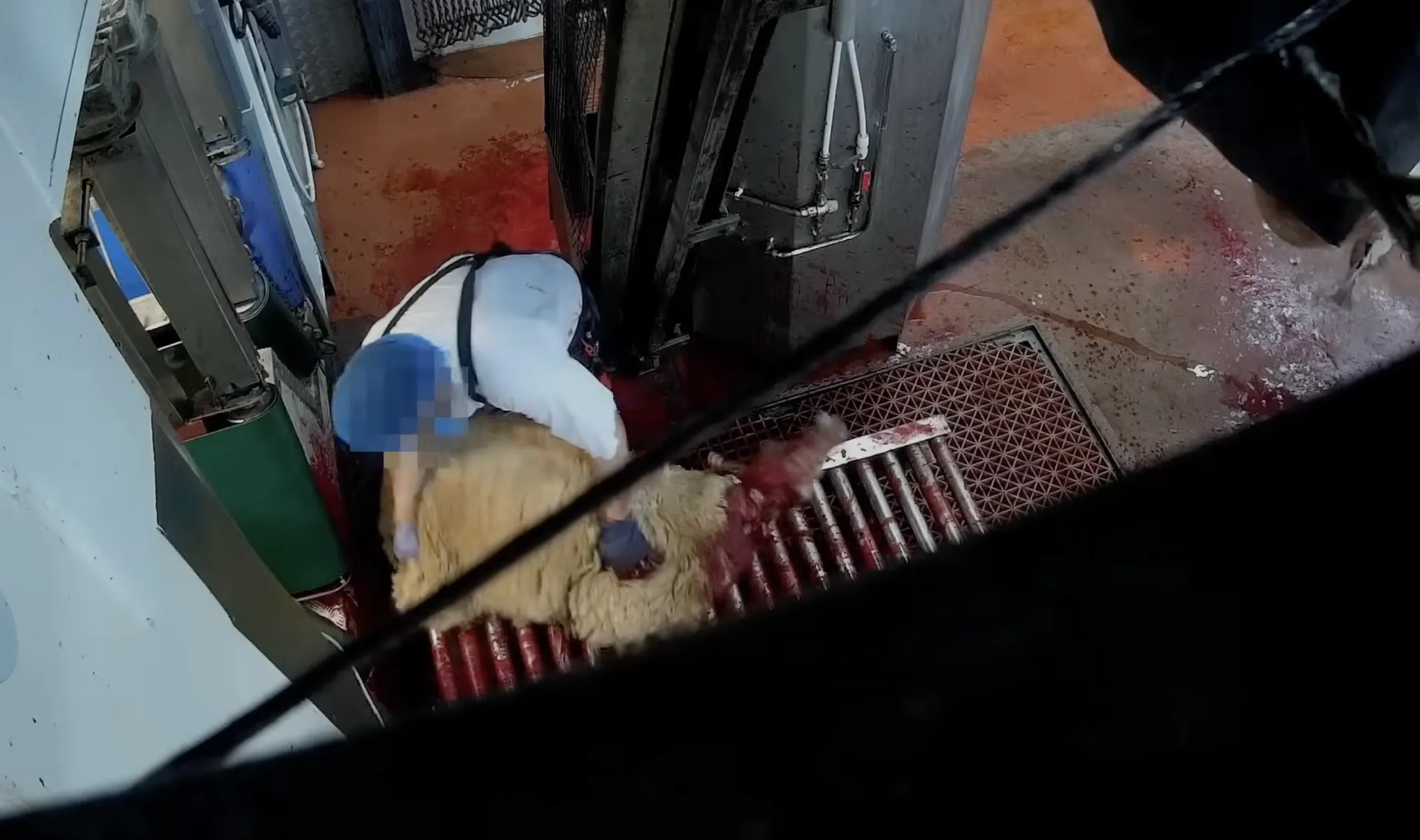
Worker handling a conscious sheep on the slaughter line
Source: Still from “HALAL SLAUGHTERHOUSE EXPOSED IN ENGLAND (EXTREMELY GRAPHIC)”, Joey Carbstrong / YouTube. Watch on YouTube
Stress hormone data reinforces this picture. Research comparing stunned and non-stunned slaughter in chickens found that cortisol levels in non-stunned birds were nearly double those recorded in stunned birds. Cortisol is the body’s primary biochemical marker of distress. Those numbers describe terror made measurable.
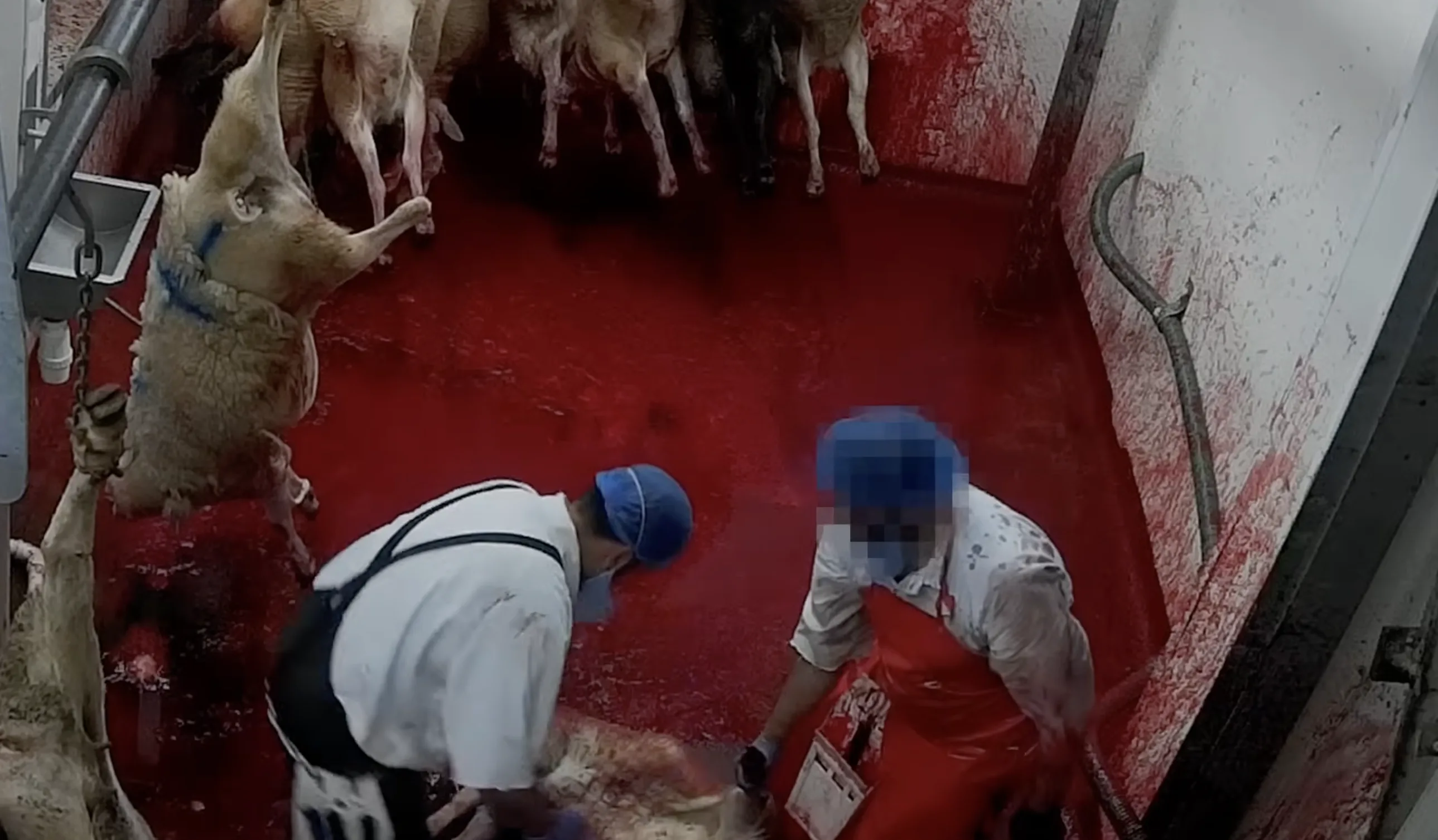
Sheep restrained for halal slaughter inside an English abattoir
Source: Still from “HALAL SLAUGHTERHOUSE EXPOSED IN ENGLAND (EXTREMELY GRAPHIC)”, Joey Carbstrong / YouTube. Watch on YouTube
Waterfowl fare even worse in the data. A study measuring time to loss of consciousness in ducks following non-stunned commercial slaughter found that some birds took up to 383 seconds to lose consciousness. That is over six minutes of conscious bleeding out on the slaughter floor.
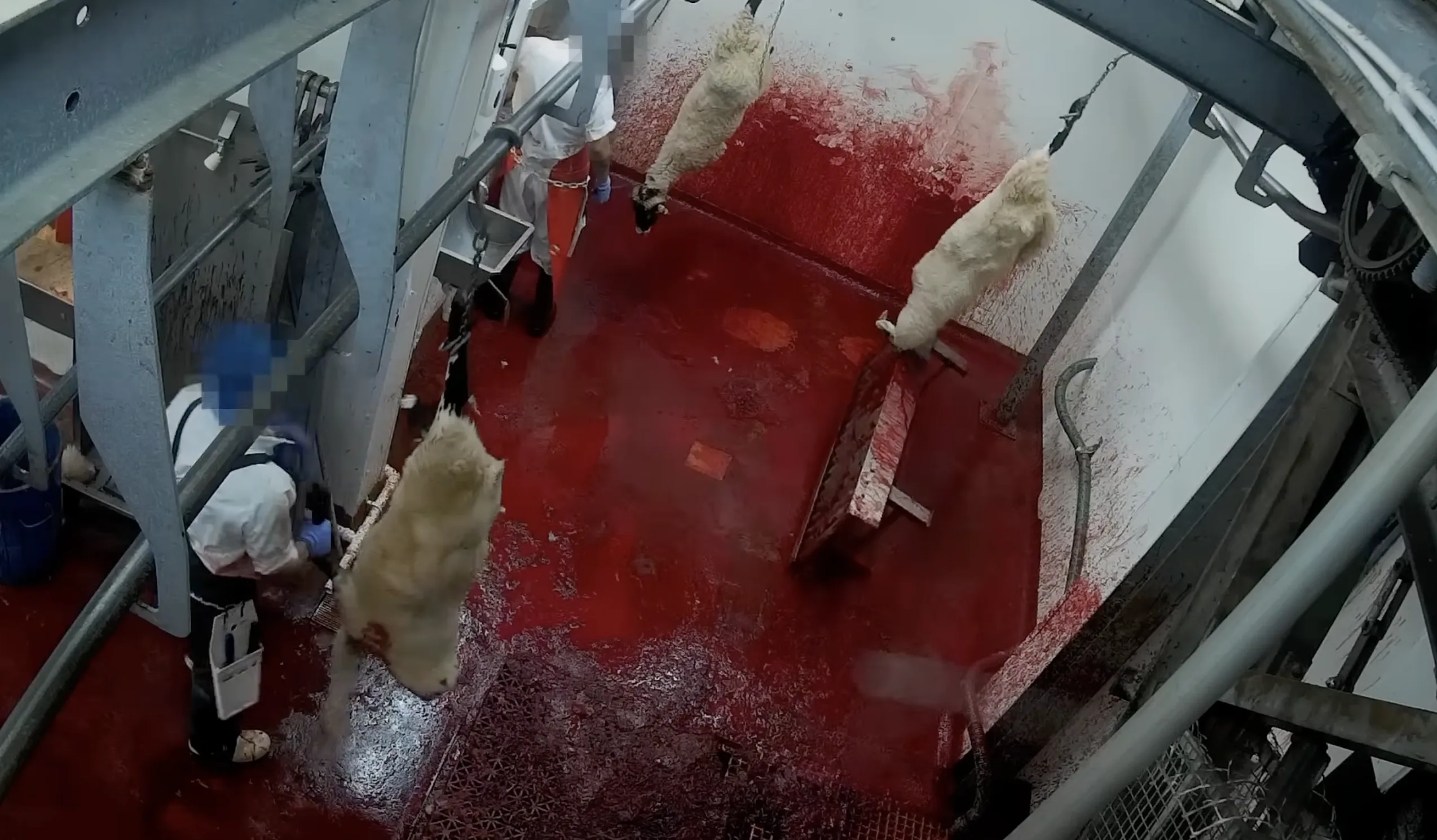
Throat cut being performed on a sheep at a halal slaughter facility
Source: Still from “HALAL SLAUGHTERHOUSE EXPOSED IN ENGLAND (EXTREMELY GRAPHIC)”, Joey Carbstrong / YouTube. Watch on YouTube
Then there is the problem of execution. The ideal halal cut is precise, performed with an exceptionally sharp blade in a single motion. In commercial industrial settings, this ideal often collides with reality. Animals may be struck and beaten to force them into slaughter facilities. Those that fall may be whipped to make them rise. Animals are transported for days in overcrowded, poorly ventilated trucks, particularly in hot and humid conditions, arriving at slaughter already exhausted and traumatised. Poor knife maintenance, inadequate restraint, and undertrained operators compound the suffering at the point of killing itself.
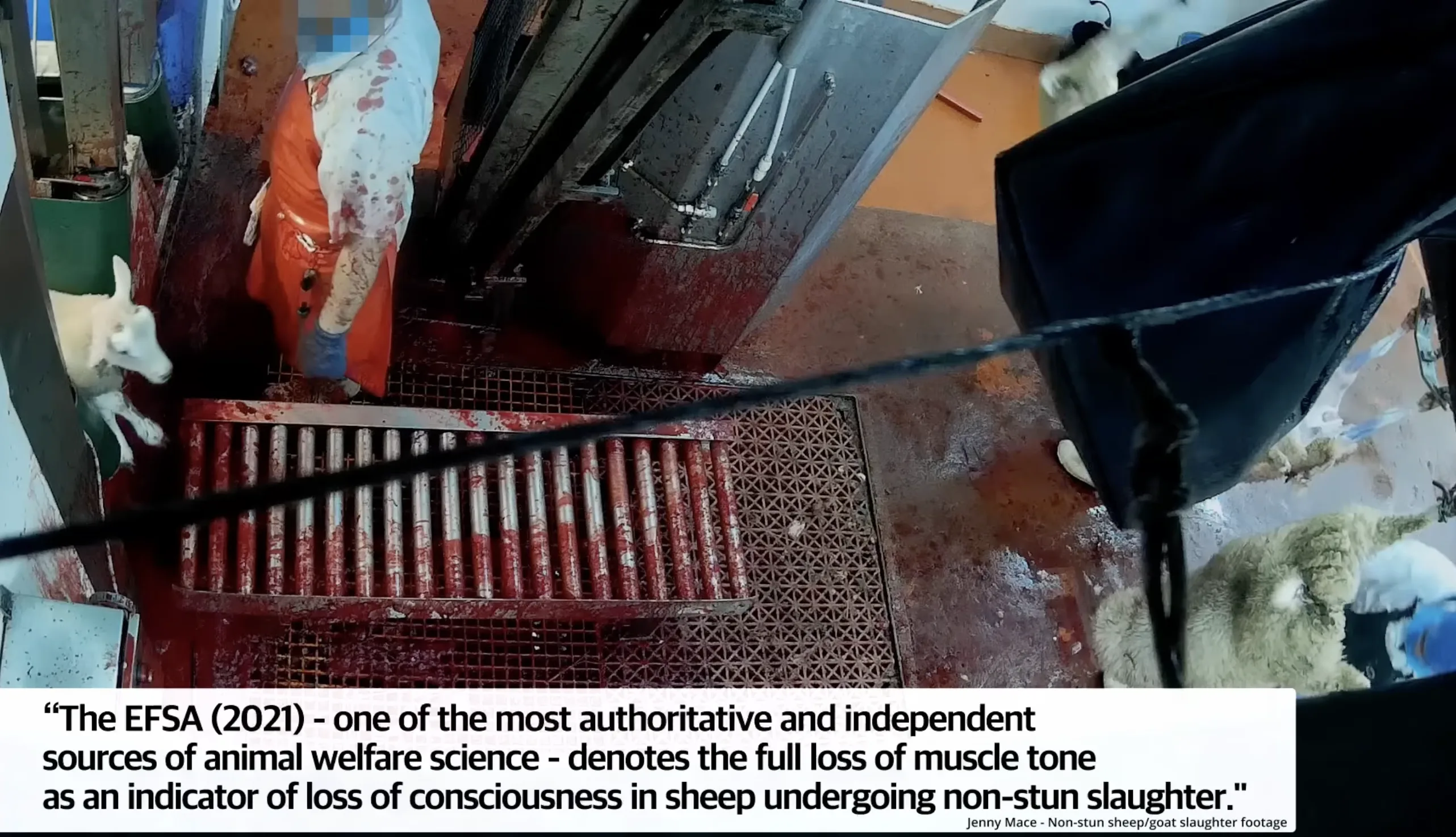
Blood on the slaughter floor after a sheep has been cut while conscious
Source: Still from “HALAL SLAUGHTERHOUSE EXPOSED IN ENGLAND (EXTREMELY GRAPHIC)”, Joey Carbstrong / YouTube. Watch on YouTube
Missed stuns, where pre-stunning is used but fails due to poor equipment maintenance, improper application, or inadequate restraint, necessitate additional stunning attempts, which further aggravate pain and stress in animals.
The European Food Safety Authority and the Federation of Veterinarians of Europe have both concluded that non-stunned slaughter compromises animal welfare, as animals experience the full sensory impact of the throat cut.
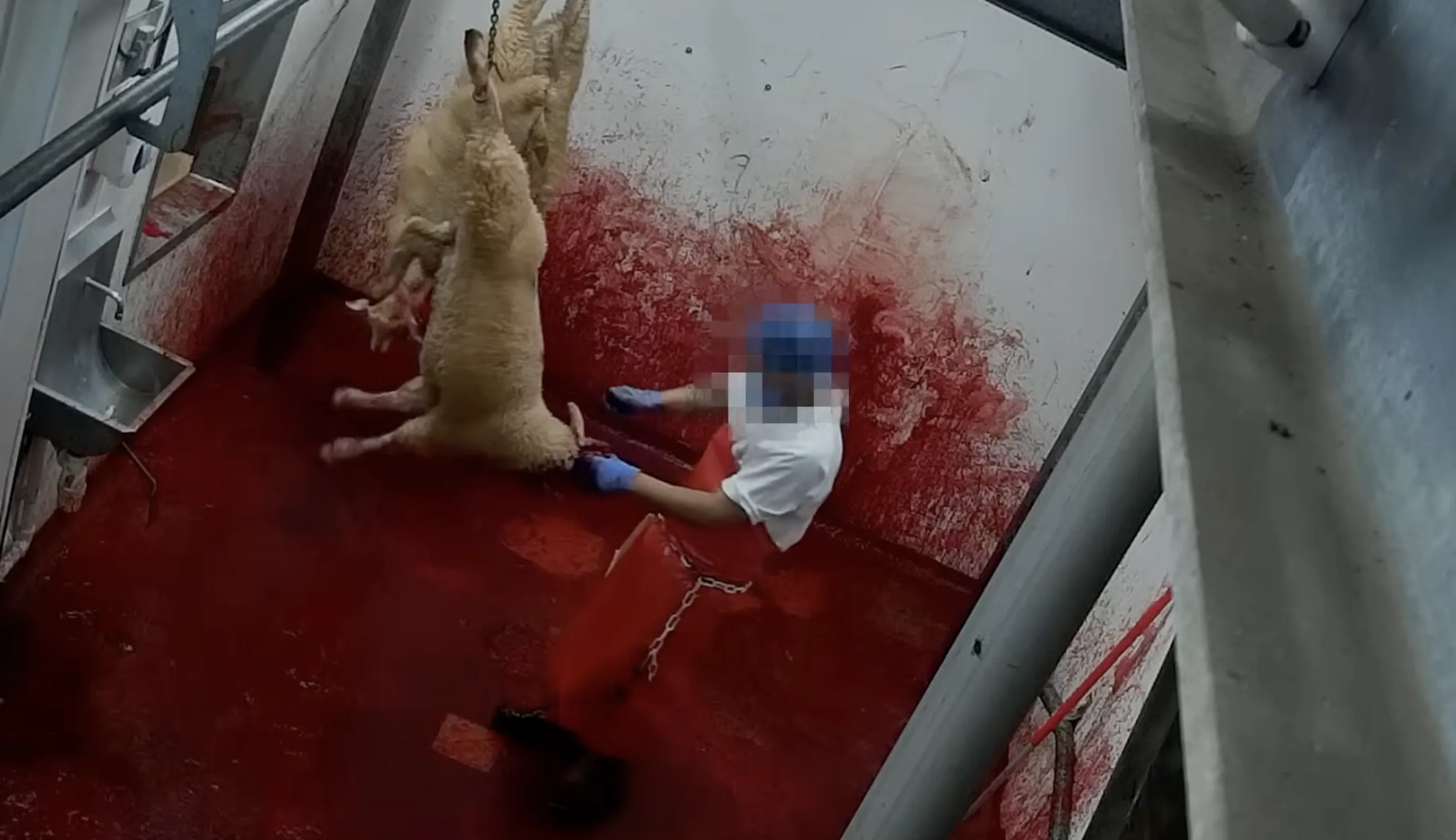
Sheep bleeding out on the kill line inside a halal slaughterhouse
Source: Still from “HALAL SLAUGHTERHOUSE EXPOSED IN ENGLAND (EXTREMELY GRAPHIC)”, Joey Carbstrong / YouTube. Watch on YouTube
The defenders of non-stunned halal slaughter point to rapid blood pressure collapse inducing near-instant unconsciousness, and some studies, particularly on small ruminants with clean cuts, do support a short window. But the evidence overall is asymmetric: the worst-case outcomes, documented on EEG, in cortisol readings, and in behavioural observation, involve prolonged, measurable, conscious suffering. The debate is not truly about whether suffering occurs. It is about how much, for how long, and whether religious tradition outweighs that biological reality.
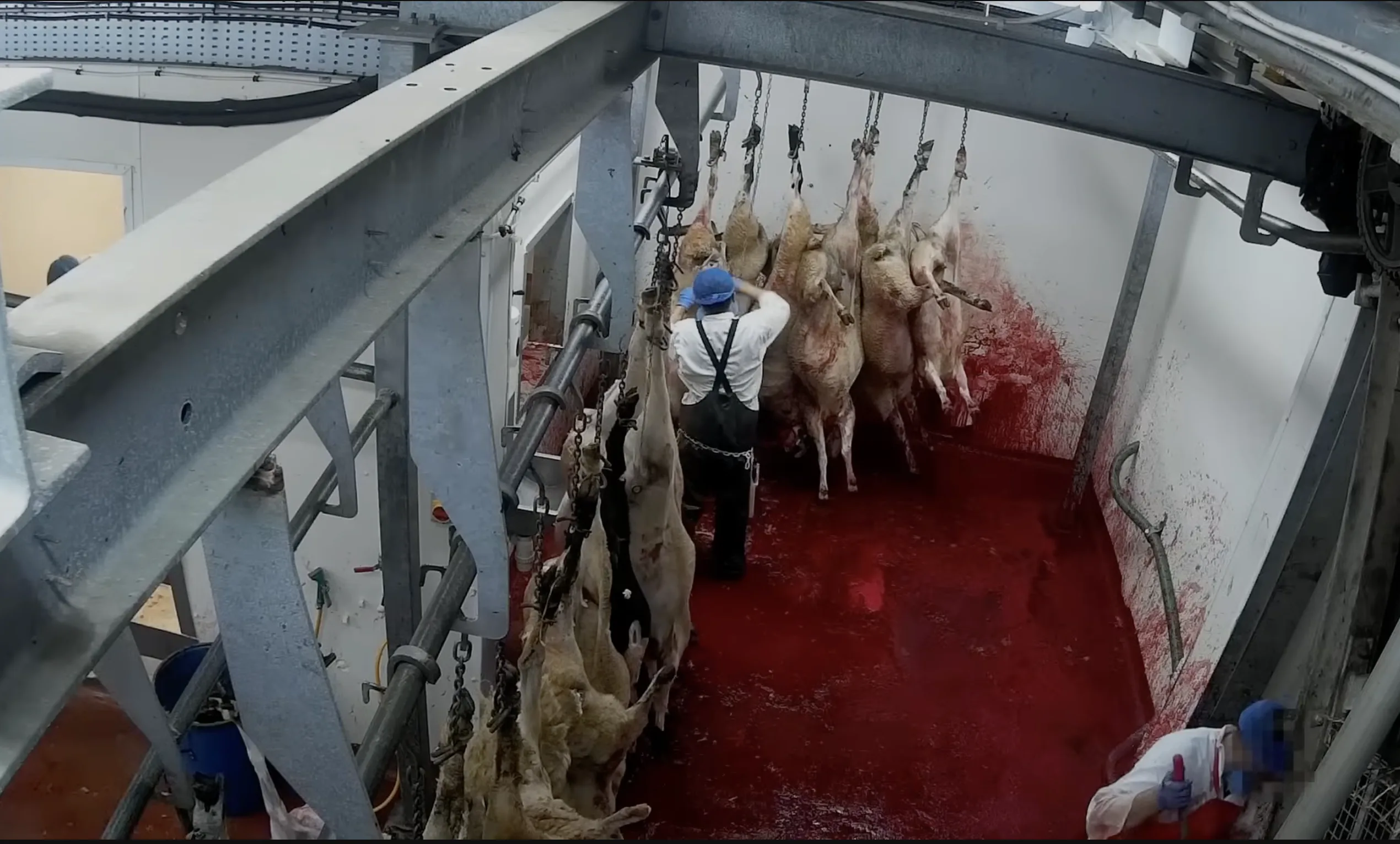
Distressed sheep handled by workers inside an English halal abattoir
Source: Still from “HALAL SLAUGHTERHOUSE EXPOSED IN ENGLAND (EXTREMELY GRAPHIC)”, Joey Carbstrong / YouTube. Watch on YouTube

Halal duck slaughter. The median time to loss of balance following the neck cut was 166 ± 14 (22–355) seconds. 166 seconds is nearly 3 minutes 355 seconds is 6 minutes.


🚨 À quelques heures de l’Aïd, les vols de brebis se multiplient en France. À Saint-Gély-du-Fesc, près de Montpellier, un éleveur a constaté le vol de 35 brebis.
